Introduction
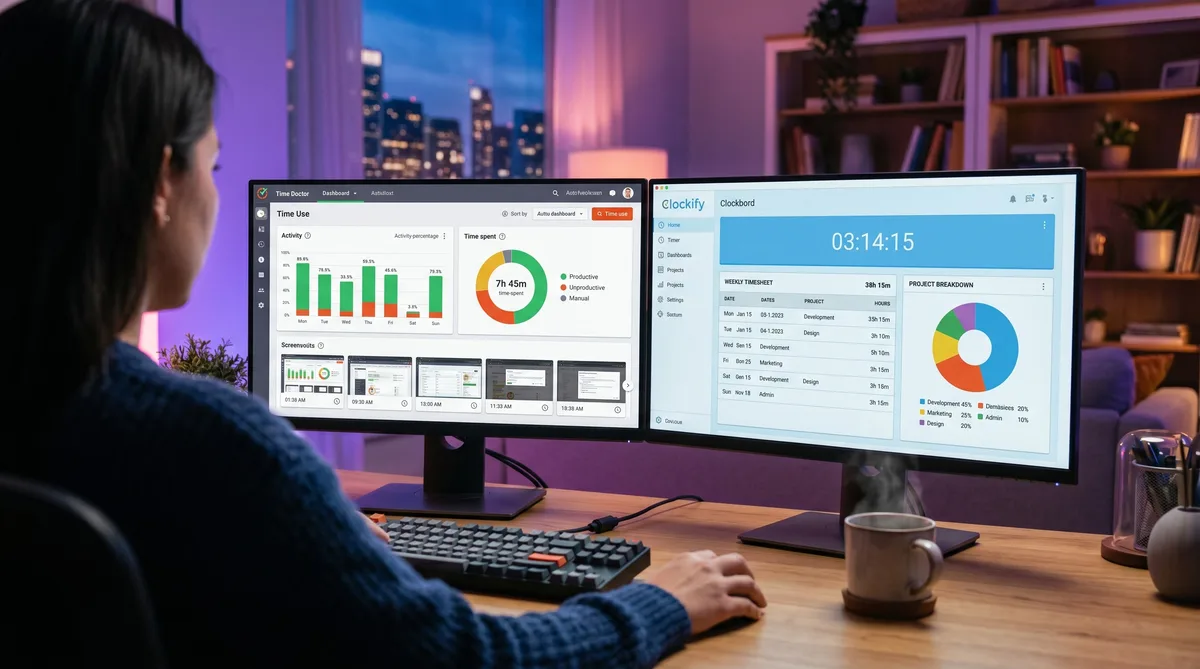
At first glance Time Doctor and Clockify look like they belong in the same shortlist: both track time, both run on every platform, and both can capture screenshots of a working day. Look closer, though, and they are built around opposite priorities. Time Doctor is a monitoring platform first and a timer second. Clockify is a budget timer first, with monitoring bolted on as an option you can ignore entirely.
That single difference cascades into everything: how much you pay, whether there is a free plan, when screenshots appear, and how your team feels about the software on their machines. Pick the wrong one and you either overpay for surveillance you did not need, or you find yourself unable to verify a single billed hour.
This guide compares Time Doctor and Clockify across pricing, features, monitoring, and free plans in 2026. For the standalone deep dives, see our Time Doctor review and Clockify review. Here we put them head to head.
Want adjacent matchups? See Hubstaff vs Clockify for another monitoring-vs-budget pairing, or Toggl vs Time Doctor for a trust-based timer against Time Doctor.
Time Doctor Overview
Time Doctor launched in 2012 as an employee-monitoring and productivity-analytics platform. Its natural customers are BPOs, outsourcing firms, call centers, and remote-first companies that need to verify exactly what a distributed workforce is doing during paid hours.
Who Is Time Doctor For?
Time Doctor is for managers who need accountability, not just hours. If you pay people by tracked time and need evidence the time was worked, especially across contractors you cannot see, Time Doctor is built for that. For a closer look at how its tracking behaves day to day, see our Time Doctor guide.
Key Selling Points
- Screenshots and activity tracking — Periodic screenshots plus keyboard and mouse activity levels, available from the entry Basic plan.
- Distraction alerts — A pop-up nudges the worker when they linger on a non-work site, a signature Time Doctor feature.
- Productivity ratings — Categorizes apps and websites into productive and unproductive buckets and scores them (Standard and up).
- Built-in payroll — Pays workers automatically from tracked, verified hours, popular with outsourcing firms.
- Advanced monitoring on Premium — Video screen recording, unusual-activity reports, and mouse-jiggler/clicker detection for maximum oversight.
- Cross-platform — Windows, macOS, Linux, and mobile, with 60+ integrations.
Time Doctor's strength is depth of oversight; its cost is friction. There is no free plan, and the always-on capture can make employees feel watched. For monitoring-heavy teams that is acceptable; for a casual timer it is overkill.
Clockify Overview
Clockify entered the market in 2017 with a famous pitch: 100% free time tracking. That strategy attracted millions of users. In 2026, Clockify capped its free plan at five users — the old unlimited-user free tier is gone — but everything within those five seats stays unlimited, and the paid plans remain the cheapest in the category. Our full Clockify review covers the change in detail.
Who Is Clockify For?
Clockify is ideal for budget-conscious teams, freelancers, and agencies that need accurate hours and billing without paying monitoring-suite prices. Crucially, monitoring is available if you ever need it — it is simply optional rather than the whole point.
Key Selling Points
- Genuinely free plan — Free for up to five users with unlimited projects and time tracking. Not a trial.
- Lowest paid pricing — Paid tiers start at just $3.99 per user per month billed annually.
- Optional monitoring — Screenshots, GPS, and an activity auto-tracker are available on the Pro plan, and off by default.
- Invoicing and approvals — Built-in invoicing, timesheet approvals, and time-off management on the Standard plan and up.
- Kiosk mode — Shared-device clock-in, free on all plans, useful for on-site teams.
- Cross-platform — Windows, macOS, Linux, iOS, Android, browser extensions, plus 80+ integrations and Zapier.
Clockify's weakness is that its monitoring, while present, is lighter than a dedicated surveillance suite. If deep, continuous oversight is your main requirement, Clockify Pro covers the basics but Time Doctor goes further.
Feature-by-Feature Comparison
The table below maps the two tools against the features that matter most, noting which plan unlocks each.
| Feature | Time Doctor | Clockify |
|---|---|---|
| Free Plan | No — 14-day trial only | Yes — up to 5 users |
| Starting Paid Price | $6.70/user/mo (Basic, annual) | $3.99/user/mo (Basic, annual) |
| Time Tracking | Timer + automatic tracking | Timer + manual entry + timesheets |
| Screenshots | Yes, from Basic (core feature) | Optional, Pro plan only |
| Activity Levels | Yes, from Basic | Auto-tracker on Pro |
| GPS Tracking | Not a focus | Optional, Pro plan |
| Distraction Alerts | Yes (signature feature) | Not available |
| Productivity Ratings | Yes (Standard+) | Not available |
| Screen Recording | Yes (Premium) | Not available |
| Invoicing | Not built-in | Built-in (Standard+) |
| Timesheet Approvals | Yes (Standard+) | Yes (Standard+) |
| Payroll | Built-in (Standard+) | Via integrations |
| Kiosk Mode | Not available | Yes, all plans incl. free |
| Integrations | 60+ | 80+ plus Zapier |
| Posture | Monitoring-first | Budget-first, monitoring optional |
Key takeaway: Time Doctor wins on depth of monitoring and productivity analytics; Clockify wins on price, a free plan, invoicing, and flexibility. The rows split cleanly along the monitoring-first vs budget-first divide.
For a wider view of the market, see our top time tracking software roundup.
Monitoring — Core vs Optional
This is the section that should drive your decision, because monitoring is exactly where the two tools differ in philosophy, not just in features.
For Time Doctor, monitoring is the product. Screenshots and activity tracking are present from the entry Basic plan and are central to how the tool is meant to be used. Move up the tiers and the oversight deepens: productivity ratings and web/app categorization on Standard, then video screen recording and a mouse-jiggler/clicker-detection report on Premium. You adopt Time Doctor because you want this visibility.
For Clockify, monitoring is a switch you can leave off. The free and lower paid tiers are pure time tracking. Screenshots, GPS, and the activity auto-tracker only appear on the Pro plan, and they are optional even there. A team can run Clockify for years and never enable a single monitoring feature — or turn them on later if a client demands verified hours. That flexibility is the whole pitch.
So the real question is not "which monitors more" — Time Doctor does — but "do you want monitoring to be the foundation or an option?" If verification is your core need, Time Doctor's depth justifies its price. If you mainly need affordable, accurate tracking and want monitoring only as a safety valve, Clockify gives you that for far less.
If heavy monitoring is genuinely the requirement, it is worth comparing the dedicated suites against each other. Our Hubstaff vs Time Doctor comparison weighs the two biggest surveillance platforms, and the broader guide to employee monitoring software maps the whole category.
Pricing Comparison
Pricing is the clearest separator. Clockify is cheaper at every level and adds a free plan on top; Time Doctor charges more but bundles deep monitoring from the entry tier. All prices below are per user per month, billed annually.
Time Doctor Pricing (2026)
| Plan | Price (Annual Billing) | Key Additions |
|---|---|---|
| Basic | $6.70 /user/month | Time tracking, projects & tasks, screenshots, timeline report, online/offline tracking |
| Standard | $11.70 /user/month | Productivity ratings, web & app usage, payroll, 60+ integrations, attendance, time approvals |
| Premium | $16.70 /user/month | Video screen recording, unusual-activity AI, mouse-jiggler/clicker detection, executive dashboard, SSO |
| Enterprise | Custom pricing | Private cloud deployment, custom BI dashboards, guided implementation, custom contracts |
Time Doctor has no free plan — just a 14-day trial of Premium.
Clockify Pricing (2026)
| Plan | Price (Annual Billing) | Key Additions |
|---|---|---|
| Free | $0 (up to 5 users) | Unlimited tracking, projects, kiosk mode, auto-tracker, basic reports, calendar view |
| Basic | $3.99 /user/month | Administration, time audit, custom fields, billable rates, required fields |
| Standard | $5.49 /user/month | Invoicing, timesheet approvals, time off / PTO, manager roles, bulk edits |
| Pro | $7.99 /user/month | Screenshots, GPS tracking, scheduling, expenses, labor cost & profit, budget alerts |
| Enterprise | $11.99 /user/month | SSO/SAML, custom subdomain, audit log, account manager, on-premises option |
Cost Comparison for Real Teams
Here is what each tool costs for a team of 10, billed annually:
- Clockify Standard (10 users): $54.90 per month ($658.80/year) — invoicing, approvals, time-off, no monitoring
- Clockify Pro (10 users): $79.90 per month ($958.80/year) — adds optional screenshots and GPS
- Time Doctor Basic (10 users): $67 per month ($804/year) — screenshots and activity from day one
- Time Doctor Standard (10 users): $117 per month ($1,404/year) — adds productivity ratings and payroll
The neatest comparison is monitoring to monitoring: Clockify Pro at $79.90/month undercuts Time Doctor Standard at $117/month while adding screenshots, GPS, and invoicing. Time Doctor's edge is not price — it is the depth of its analytics (productivity ratings, distraction alerts, screen recording) that Clockify simply does not match. You pay more for Time Doctor because you are buying a heavier monitoring engine, not just a tracker with screenshots.
The Free Plan Question
For many small teams this section settles the matter on its own. Clockify has a free plan; Time Doctor does not.
Clockify's free tier covers up to five users with unlimited projects and time tracking, indefinitely. It does not include monitoring, invoicing, or approvals, but for a freelancer or a small team that just needs to log hours, it is genuinely enough. Time Doctor offers only a 14-day trial of Premium; after that, every seat is paid.
The catch is that Clockify's free plan is just a timer — no screenshots, no activity proof. So the free plan only helps if tracking, not verification, is what you need. The moment your requirement becomes "prove the time was worked," you are comparing paid Clockify Pro against paid Time Doctor, and the decision shifts back to depth versus price. Note too that Clockify's free plan does not lock timesheets, so entries remain editable after the fact — fine for trust-based teams, a problem for strict audit trails.
Take Breaks Without Affecting Your Reports
Time Doctor and Clockify Pro both track your activity. TrickTack keeps your reports consistent while you step away.
DownloadPros and Cons
Time Doctor
Pros
- Deep monitoring — Screenshots and activity from the entry tier, plus distraction alerts and screen recording higher up.
- Productivity analytics — Web/app categorization and ratings give managers real, comparable data.
- Built-in payroll — Pay workers automatically from verified hours, ideal for BPOs.
- Purpose-built for oversight — If verification is the job, this tool does it thoroughly.
Cons
- No free plan — Only a 14-day trial; you pay from day 15.
- Higher price — Every tier costs more than Clockify's equivalent.
- Surveillance friction — Always-on capture can erode trust if rolled out poorly.
- Overkill for simple tracking — Far more tool than a freelancer or trust-based team needs.
Clockify
Pros
- Genuinely free plan — Up to five users with unlimited projects and tracking.
- Lowest paid pricing — Paid tiers from $3.99/user/month; even monitoring (Pro) undercuts Time Doctor.
- Optional monitoring — Screenshots and GPS available on Pro but off by default.
- Built-in invoicing — Bill clients from tracked hours without a third-party tool.
- Flexible — Start as a pure timer, add oversight only if you ever need it.
Cons
- Lighter monitoring — Pro covers the basics but lacks Time Doctor's distraction alerts, ratings, and screen recording.
- Free plan caps at 5 users — The old unlimited-user free tier ended in 2026.
- Free plan lacks timesheet locking — Entries stay editable, a compliance risk for some.
- Busier interface — More features and menus than a minimalist timer.
Verdict — Which Should You Choose?
Match the tool to your actual need rather than hunting for an overall winner.
For Budget-Conscious Teams and Freelancers
Choose Clockify. If you mainly need accurate tracking, billing, and budgets, Clockify wins on every cost dimension — a free plan for small teams and the cheapest paid tiers if you grow. You can always switch on monitoring via Pro later, which makes it a safe default even if your needs might change.
For Remote-Heavy and Outsourcing Operations
Choose Time Doctor. When you pay by tracked hours across a distributed or contractor workforce and need verifiable proof of work, Time Doctor is purpose-built for it: screenshots and activity from the entry tier, productivity ratings, distraction alerts, and built-in payroll. The higher price buys depth Clockify does not match. Roll it out transparently to avoid trust damage.
For Teams That Might Need Monitoring Later
Start with Clockify. Because monitoring is an optional Pro feature rather than the foundation, Clockify lets you begin cheaply and escalate only if a client or compliance rule forces the issue. If that day comes and Clockify Pro's monitoring proves too light, you will at least know exactly what depth you need before paying Time Doctor prices.
Still weighing it up? Both have solid mobile apps, and our top time tracking software roundup places them in the wider field. To see Time Doctor against a lighter analytics tool, read DeskTime vs Time Doctor.
Both Can Track You — How to Take Breaks
Whichever tool wins your evaluation, the person being tracked faces the same reality: activity can be recorded throughout the workday. Time Doctor does it by default, with screenshots and activity levels. Clockify can do it too once Pro monitoring is switched on. Either way, stepping away from the keyboard leaves a gap.
That gap matters more than it should. A coffee break, a phone call, or ten minutes reading on paper can register as "idle" or "unproductive," making an honest, focused worker look disengaged on a dashboard they never see.
Trick Tack is a lightweight desktop app that keeps your activity steady while you are briefly away. It simulates natural mouse movement, keystrokes, scrolling, and app-switching, so short breaks do not turn into red flags on a report. It works alongside any tracker, including Time Doctor, Clockify, Hubstaff, and Toggl.
- Simulates human-like mouse, keyboard, and scrolling activity
- Works with any time tracking or employee monitoring software
- Runs quietly in the background on Windows
- 7-day free trial — cancel anytime
A note on Time Doctor specifically: its Premium plan advertises mouse-jiggler and clicker detection aimed at crude, repetitive automation. Trick Tack focuses on natural, varied input rather than the robotic patterns those checks target, but no tool can promise to be undetectable — and using one against your employer's policy is a real risk you should weigh for yourself.
Frequently Asked Questions
What is the main difference between Time Doctor and Clockify?
The difference is focus. Time Doctor is a monitoring-first platform: screenshots, activity levels, distraction alerts, and productivity ratings are the core of the product, available from its entry tier. Clockify is a budget time tracker first: it leads with a free plan and very low paid pricing, and treats monitoring as an optional add-on that only appears on its Pro plan. In short, Time Doctor is built to watch how work happens, while Clockify is built to log hours cheaply and lets you switch monitoring on only if you need it.
Is Time Doctor or Clockify cheaper?
Clockify is significantly cheaper. It has a genuinely free plan for up to five users, and its paid tiers start at just $3.99 per user per month billed annually. Time Doctor has no free plan, only a 14-day trial, and its entry-level Basic plan costs $6.70 per user per month billed annually. Even comparing monitoring to monitoring, Clockify Pro at $7.99, which adds screenshots and GPS, undercuts Time Doctor Standard at $11.70.
Does Clockify have screenshots and monitoring like Time Doctor?
Yes, but only on its top Pro plan and only if you choose to enable it. Clockify Pro ($7.99 per user per month annually) adds screenshots, GPS tracking, and an activity auto-tracker. Monitoring is off by default and optional. Time Doctor, by contrast, includes screenshots and activity tracking from its entry Basic plan and is designed around continuous monitoring, adding video screen recording and mouse-jiggler detection on Premium.
Does Time Doctor have a free plan?
No. Time Doctor offers only a 14-day free trial of its Premium features, after which you must choose a paid plan. Clockify does have a permanent free plan, which in 2026 supports up to five users with unlimited projects and time tracking, though it does not include monitoring features. If a free plan is important to you, Clockify is the only one of the two that offers it.
Which is better for a small remote team?
It depends on whether you need verification or just hours. If you simply need to track time and budgets cheaply, Clockify wins easily thanks to its free plan and low paid pricing, with the option to turn on monitoring later via Pro. If your priority is proof of work from a remote or outsourced team, Time Doctor is purpose-built for it, with screenshots and activity tracking from the entry tier, productivity ratings, and built-in payroll. Many cost-conscious teams start on Clockify and only move to Time Doctor if they specifically need heavier oversight.
Conclusion
Time Doctor and Clockify answer different questions. Time Doctor asks "can I prove this time was worked?" and answers it with screenshots, activity scores, distraction alerts, and productivity analytics from the very first tier. Clockify asks "how do I track time and bill for it as cheaply as possible?" and answers it with a free plan, the lowest paid pricing in the category, and monitoring kept as an optional extra.
If oversight is your foundation, Time Doctor earns its higher price — the details are in our Time Doctor review. If price and flexibility matter most and monitoring is at most a maybe, Clockify is the smarter default — see our Clockify review for the full picture. Decide whether you are buying a monitor or a timer, and the choice makes itself.
Whichever you pick, both can record activity all day. If you want short breaks to stay invisible on the report, Trick Tack keeps things consistent in the background.
Try TrickTack Free for 7 Days
Keep your reports consistent with Time Doctor, Clockify, or any other tracker. Cancel anytime during your trial.
Download

