For a focused employee-side explanation, see our Clockify screenshots guide: Check screenshot settings, handle accidental private captures, and understand the consequences for your recorded time.
What Is Clockify?
Clockify is a time tracking and timesheet app that built its reputation on being radically cheap. Launched in 2017 by CAKE.com, it grew to more than four million users largely on the strength of a free plan that, for years, placed no limit on the number of users — an offer no major competitor matched.
That free plan is still here, but as of 2026 it has changed: the free tier now caps at five users (more on that in the pricing section). Even so, Clockify remains the value leader in the category — its paid tiers undercut nearly every rival, and uniquely for a budget tracker, it offers optional screenshots and GPS on its Pro plan, letting it double as a light employee-monitoring tool when you need one.
This review covers Clockify's core features, its current 2026 pricing, the trade-offs to weigh, and the strongest alternatives. If you want to see it head-to-head, we compare it directly in Toggl vs Clockify and Hubstaff vs Clockify. For a detailed look at how Clockify's tracking features work, see our guide on how to cheat Clockify. Our broader guide to time tracking software covers all major tools.
Key Clockify Features
Time Tracking and Timesheets
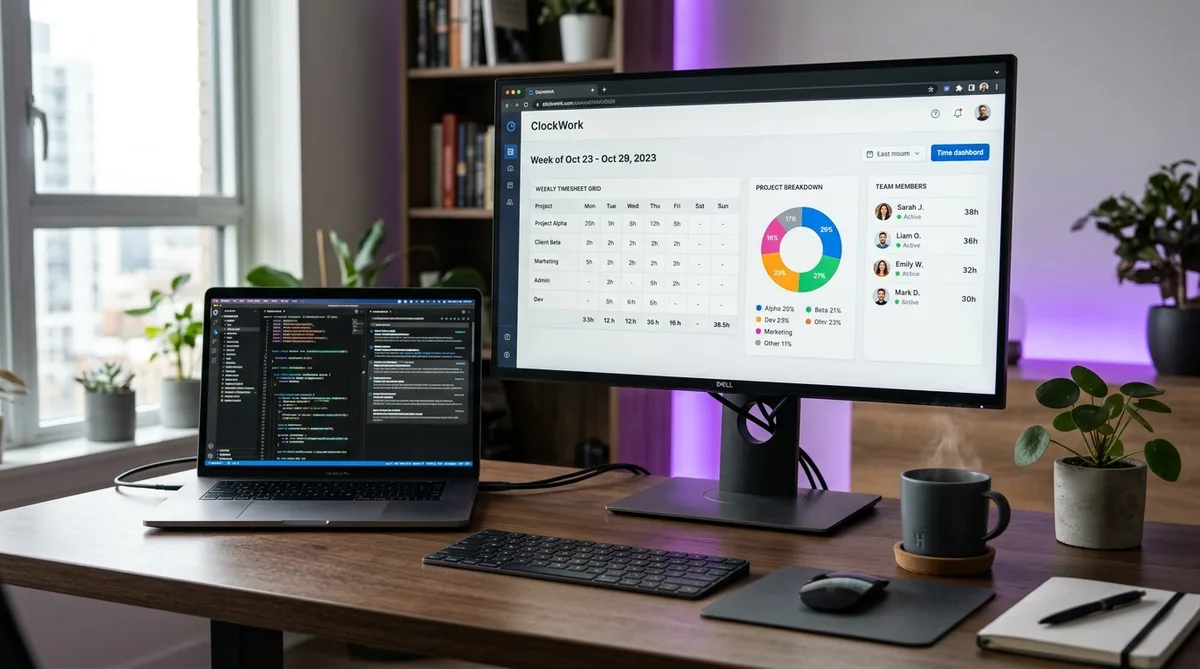
At its core, Clockify is a flexible timer and timesheet. You can run a live timer, enter time manually, or fill in a weekly timesheet grid — whichever fits how you work. Every entry can be tagged with a project, client, task, and labels, and marked billable or non-billable. There is no automatic surveillance on the standard plans; what gets tracked is in the user's hands.
Clockify also includes niceties that many pricier tools charge for: a Pomodoro timer, idle detection, a calendar view, auto-start/stop, and kiosk mode, which turns a shared tablet into a clock-in station for on-site staff. Projects, clients, and tasks are unlimited even on the free plan.
Reports, Billing, and Invoicing
Clockify turns tracked time into summary, detailed, and weekly reports that filter by project, client, user, or tag and export to PDF, CSV, or Excel. Billable rates can be set at the workspace, project, member, or task level, so hours convert straight into billable amounts.
From the Standard plan up, Clockify adds invoicing — generate and send client invoices directly from tracked time — along with time-off and PTO management and timesheet approvals. Higher tiers add expenses, project budgets, and profitability (labor cost versus revenue), which pushes Clockify from a simple tracker toward a full project-accounting tool.
Optional Monitoring on Pro
Here is what makes Clockify unusual among budget trackers: on the Pro plan, it offers genuine employee-monitoring features. Administrators can enable screenshots, activity-level tracking, and GPS location on mobile — the same kinds of features that define dedicated monitoring tools like Hubstaff and Time Doctor.
Crucially, these are off by default and gated to Pro. The free, Basic, and Standard plans have no screenshot or GPS capability at all, so lighter-touch teams never touch surveillance. This tiering lets one tool serve two very different buyers: a trust-based tracker for most, and an optional monitor for managers who specifically need proof of work.
Integrations and Platforms
Clockify connects to 80+ tools — Asana, Jira, Trello, QuickBooks, Google Calendar, and more — mostly through its browser extension, which adds a one-click timer inside those apps. On platforms it is genuinely everywhere: native desktop apps for Windows, macOS, and Linux, iOS and Android apps, a web app, and Chrome, Firefox, and Edge extensions, with offline tracking that syncs on reconnect.
Clockify Pricing in 2026
Clockify uses per-user, per-month pricing across a free plan and four paid tiers. The rates below are the annual-billing prices; monthly billing costs more (for example, Basic is $4.99 monthly versus $3.99 annually). All paid features can be trialed free for 7 days with no credit card.
| Plan | Price (annual, per user/mo) | Best for |
|---|---|---|
| Free | $0 (up to 5 users) | Solo users and small teams |
| Basic | $3.99 | Teams needing unlimited seats |
| Standard | $5.49 | Billing, invoicing, approvals |
| Pro | $7.99 | Monitoring and profitability |
| Enterprise | $11.99 | Security, SSO, large orgs |
Free — $0 (up to 5 users)
- Unlimited projects, clients, tasks, and time tracking
- Timer, manual entry, weekly timesheets, and calendar
- Idle detection, Pomodoro, kiosk mode, and basic reports
- Apps on every platform — no time limit, no credit card
Basic — $3.99/user/month (billed annually)
- Everything in Free, with unlimited paid users
- Administrative controls and bulk edit
- Time audit and data-accuracy tools
- Hide pages and customize the workspace
Standard — $5.49/user/month (billed annually)
- Everything in Basic
- Invoicing and billable-amount reports
- Time off and PTO management
- Timesheet approvals and manager roles
Pro — $7.99/user/month (billed annually)
- Everything in Standard
- Screenshots, activity tracking, and GPS (optional)
- Scheduling, expenses, and project profitability
- Forecasting, custom reports, and alerts
The big 2026 change is the free plan: Clockify historically offered unlimited free users, and that is what made it famous. The free tier is now capped at five users, so a growing team that used to ride Clockify for free will hit the Basic plan ($3.99/user) at the sixth seat. It is still excellent value — even Toggl charges $9 for its entry tier, and dedicated monitors cost more — but the headline "free forever for any team size" no longer holds.
Pros and Cons
What Clockify Does Well
- Cheapest in its class — Paid tiers start at $3.99 and top out at $11.99; almost every rival costs more for comparable features.
- Generous free plan — Five users with unlimited projects, tracking, and timesheets, no expiry and no credit card.
- Optional monitoring — Screenshots, activity, and GPS on Pro make Clockify a rare budget tracker that can also serve as a light monitor.
- Deep feature set — Invoicing, time off, approvals, scheduling, expenses, and kiosk mode rival far pricier suites.
- Cross-platform with offline support — Native apps for Windows, macOS, Linux, iOS, and Android.
Where Clockify Falls Short
- Free plan no longer unlimited — The 2026 five-user cap removes the single biggest reason large teams chose Clockify.
- Monitoring and profitability gated to Pro — The most powerful features only appear at $7.99/user.
- Busier interface — With so many features, Clockify can feel more cluttered and less polished than Toggl.
- Reporting depth varies by tier — Some custom reports and admin controls sit behind higher plans.
- Support skews self-serve — Lower tiers rely mostly on documentation and email rather than hands-on help.
Clockify Alternatives
Toggl Track
Toggl Track is Clockify's closest rival on the "light, trust-based tracker" side. Toggl has the cleaner interface and slightly stronger reporting, but its paid plans cost noticeably more and its free tier also caps at five users. If polish matters more than price, Toggl wins; if value is everything, Clockify does. See Toggl vs Clockify for the full breakdown.
Hubstaff and Time Doctor
If monitoring is your actual goal, dedicated tools like Hubstaff and Time Doctor go deeper than Clockify Pro — richer screenshot controls, always-on activity scoring, and (for Hubstaff) full GPS and geofencing. They cost more and feel more surveillance-heavy. Compare the budget-versus-monitoring trade-off in Hubstaff vs Clockify.
Harvest
If your priority is billing clients and getting paid, Harvest pairs time tracking with polished invoicing and payments in one place. Clockify includes invoicing from the Standard plan, but Harvest's billing workflow is more refined for invoice-first businesses.
TrickTack
If your team is on Clockify Pro with screenshots and activity tracking switched on — or you just want the idle timer to keep running through calls and reading — TrickTack simulates the natural mouse movement, keystrokes, and scrolling that activity tracking measures. You can see exactly what it generates in the documentation.
Keep Your Clockify Activity Consistent
If your team runs Clockify Pro with activity tracking, TrickTack simulates mouse, keyboard, and scrolling input so a quiet stretch of focused work doesn't read as idle. Try it free for 7 days.
DownloadFrequently Asked Questions
How much does Clockify cost?
Clockify has a free plan and four paid tiers, priced per user per month. The headline rates are billed annually; monthly billing costs more. Free is $0 for up to five users with unlimited projects and tracking. Basic is $3.99/user/month annually ($4.99 monthly) and adds unlimited paid users, admin controls, and a time audit. Standard is $5.49/user/month annually ($6.99 monthly) and adds invoicing, time off, and timesheet approvals. Pro is $7.99/user/month annually ($9.99 monthly) and adds screenshots, GPS, scheduling, expenses, and profitability. Enterprise is $11.99/user/month annually ($14.99 monthly) and adds single sign-on and extra security. All paid features can be trialed free for seven days.
Is Clockify free, and how many users does the free plan support?
Yes, Clockify has a permanent free plan, but in 2026 it changed: the free tier now supports up to five users, where it previously allowed unlimited users. Within that limit it is still generous — unlimited projects, clients, tasks, and time tracking, plus timesheets, a calendar view, idle detection, a Pomodoro timer, kiosk mode, and apps on every platform. There is no time limit and no credit card required. Teams that need more than five users now move to the Basic plan at $3.99/user/month, which restores unlimited paid seats.
Does Clockify take screenshots?
Yes, but only on the Pro plan and above, and only if an administrator turns it on. Screenshots are part of Clockify's optional monitoring features, which also include activity-level tracking and GPS location on mobile. The free, Basic, and Standard plans have no screenshot capability at all, which keeps lighter-touch teams free of surveillance. This tiered approach lets Clockify serve both camps: a simple, trust-based tracker for most users and an employee-monitoring tool for managers who specifically want screenshots and activity proof.
What is the difference between Clockify Basic, Standard, and Pro?
Basic ($3.99/user/month annually) lifts the five-user free cap to unlimited paid seats and adds administrative controls and a time audit. Standard ($5.49) builds on that for teams that bill clients, adding invoicing, time-off and PTO management, manager roles, and timesheet approvals. Pro ($7.99) is the powerhouse tier, adding the monitoring features — screenshots, activity tracking, and GPS — plus scheduling, expenses, project profitability, forecasting, and custom reports. In short: Basic for unlimited seats, Standard for billing and approvals, Pro for monitoring and profitability.
Does Clockify work on Mac, Linux, and mobile?
Yes. Clockify has native desktop apps for Windows, macOS, and Linux, mobile apps for iOS and Android, a web app, and browser extensions for Chrome, Firefox, and Edge. The desktop apps include a menu-bar or tray timer, idle detection, and auto-start, and they support offline tracking that syncs when you reconnect. Broad platform support, including Linux, is one reason Clockify is popular with engineering teams and mixed-OS workplaces.
Conclusion
Clockify is the value leader of time tracking in 2026. No other tool packs this many features — timesheets, invoicing, time off, approvals, scheduling, expenses, and optional monitoring — into pricing that starts at $3.99 and tops out below most rivals' entry tiers. For budget-conscious teams, and especially those that want the option of screenshots and GPS without buying a dedicated monitor, it is an easy recommendation.
The one asterisk is the free plan: the famous unlimited-user tier is now capped at five seats, so large teams that planned to run Clockify for free will need the Basic plan. If you want a more polished light tracker, weigh Toggl vs Clockify; if you genuinely need deep monitoring, see Hubstaff vs Clockify.
And if your team runs Clockify Pro with activity tracking enabled and you need your activity to reflect the real work you do — including calls, reading, and focused thinking — TrickTack was built for exactly that.


