Introduction
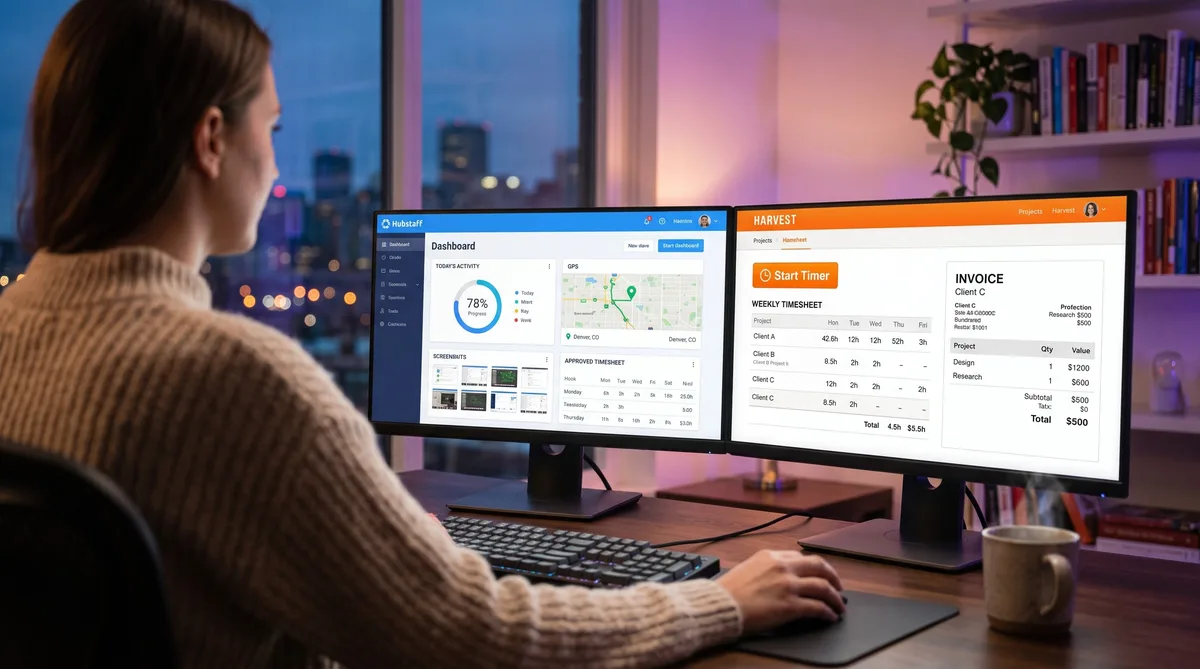
Hubstaff and Harvest both put a timer on your work, but that is where the resemblance ends. One is a monitoring platform that watches how the work happens. The other is a time-and-billing tool that simply records the hours and turns them into invoices. Choosing between them is really a choice about how much surveillance you want in the mix.
Hubstaff is a monitoring and operations suite. It measures activity levels, can take screenshots, tracks GPS location, and runs native payroll — built to verify that work happened and turn it into pay. Harvest is a lightweight time-tracking and invoicing tool. It records hours, tracks expenses, and produces clean client invoices, with no screenshots, no activity scoring, and no location tracking at all.
So the real question is how much you need to see: do you want to monitor the work or just bill for it? This guide breaks down exactly what each tool records, compares pricing tier by tier, and helps you choose. For the wider category, start with our complete guide to employee monitoring software.
Hubstaff Overview
Hubstaff launched in 2012 and grew into a full time-tracking and workforce-management platform. Its pitch: track hours, verify activity, and pay people from one app. It suits teams that need to confirm work happened and turn it into pay, especially when those people are remote or out in the field. For the full breakdown, see our Hubstaff review.
Key Features
- Time tracking — An active timer the worker starts and stops, or automatic tracking by schedule, on desktop, mobile, and web.
- Activity levels — Measures keyboard and mouse activity as a percentage. It counts input; it does not log the actual keys you press.
- Screenshots — Optional captures on paid plans, with configurable frequency and an optional blur for sensitive content.
- GPS and geofencing — Location tracking on mobile, plus job-site geofences that auto clock workers in and out.
- Payroll and invoicing — Native pay runs through Gusto and ADP, built on approved timesheets, plus budgets and client invoicing.
- App and URL tracking — Logs applications and websites during tracked time on higher tiers.
- Idle detection — Detects idle time and can prompt the user or discard it from the timesheet.
- Integrations — 30+ connections including Asana, Trello, QuickBooks, Slack, and PayPal.
Who Uses It
Hubstaff is popular with field-service businesses, agencies, and remote teams that bill clients and run payroll off tracked hours. The GPS and geofencing draw in construction, cleaning, and delivery crews who work away from a desk, while the activity scores and screenshots appeal to managers who want proof of work.
Monitoring Philosophy
Hubstaff is verification-first. It leans on activity percentages, optional screenshots, and location to confirm that work happened and to turn it into pay. It is monitoring software in the full sense, built to give managers a detailed view of the workday. To see exactly how it measures activity, read our Hubstaff activity guide.
Harvest Overview
Harvest, launched in 2006, is one of the longest-running time-tracking tools on the market, and it has stayed deliberately simple. It records hours and turns them into invoices, with no monitoring layer bolted on. For the full breakdown, see our Harvest review.
Key Features
- Time tracking — One-click timers or manual entry against projects and tasks, on desktop, web, and mobile.
- Invoicing — Professional client invoices generated from tracked hours, with online payment through Stripe and PayPal.
- Expense tracking — Log expenses and capture receipts, then bill them back to clients.
- Budgets and reporting — Project budgets, capacity and utilization reports, and profitability on higher tiers.
- Idle detection — The desktop timer notices idle time and asks whether to keep or discard it — a nudge, not surveillance.
- No monitoring — No screenshots, no activity percentages, no keystroke tracking, no GPS.
- Integrations — 50+ connections including Asana, Slack, QuickBooks, Xero, and Trello.
Who Uses It
Harvest is a favorite of agencies, consultancies, freelancers, and professional-services firms that bill clients by the hour and value a clean, trusted workflow. It fits teams where the goal is accurate billing and project profitability, not watching how each person spends their day.
Monitoring Philosophy
Harvest is trust-based by design. It assumes the hours you log are the hours you worked and gives managers project and profitability data rather than a surveillance feed. There is simply no monitoring layer to configure. To see how its timer and idle detection behave, read our Harvest tracking guide.
Feature Comparison
Here is where the two separate. The table compares every major capability so you can see exactly what each platform does.
| Capability | Hubstaff | Harvest |
|---|---|---|
| Core focus | Time tracking, monitoring, and payroll | Time tracking and invoicing |
| Activity monitoring | Yes — keyboard/mouse activity % | None — records hours only |
| Screenshots | Optional on paid plans | None |
| GPS and geofencing | Yes — location and job-site geofences | None |
| Idle detection | Yes — can discard idle time | Yes — timer prompts to keep or discard |
| Invoicing and expenses | Invoicing yes; expenses basic | Yes — a core strength |
| Payroll | Native (Gusto/ADP) | No (integrations only) |
| Keystroke logging | No content logging (activity count only) | None |
| Surveillance posture | Monitors activity and location | Trust-based, no surveillance |
| Free plan | Yes — 1 user | Yes — 1 seat, 2 projects |
The pattern could not be clearer. Hubstaff owns the monitoring layer — activity scores, screenshots, GPS, and payroll that verify and administer a workforce. Harvest owns the billing layer — clean time entry, expenses, and invoicing that turn hours into revenue, with nothing watching over your shoulder. They barely overlap outside the timer itself.
They do share one honest limit: neither logs the actual keys you type. Hubstaff counts activity but never reads your keystrokes, and Harvest does not even count activity. For anything heavier — keystroke content, screen video, location — you are looking at Hubstaff, or at a full surveillance suite like Teramind, which we cover separately.
Pricing Comparison
Pricing only makes sense next to features, because these two are not really selling the same thing. Here is what each plan costs and what it unlocks.
Hubstaff Pricing (per user/month, billed annually)
| Plan | Price | Tracking Included |
|---|---|---|
| Free | $0 (1 user) | Time tracking, limited screenshots and activity, basic reports |
| Starter | $4.99 | Time tracking, activity levels, limited screenshots, 1 integration (2-seat min) |
| Grow | $7.50 | Everything in Starter + app/URL tracking, project budgets, unlimited screenshots |
| Team | $10 | Everything in Grow + idle discard, timesheet approvals, GPS/geofencing, payroll |
| Enterprise | $25 | Everything in Team + higher limits, SSO, and priority support |
Harvest Pricing (per seat/month, billed annually)
| Plan | Price | What It Adds |
|---|---|---|
| Free | $0 (1 seat) | Time tracking, invoicing, expenses, 2 projects |
| Teams | ~$9 | Unlimited seats and projects, team reporting, accounting and payment integrations |
| Enterprise | $14 | Everything in Teams + profitability reporting, timesheet approvals, activity log, SSO |
On price the two look similar at the entry point — both are free to start, and paid seats land in the same $5–$14 range — but the dollars buy different things. Hubstaff's fee pays for monitoring and payroll; even its cheap Starter tier includes activity levels and screenshots. Harvest's fee pays for billing depth; the same money buys invoicing, expenses, and profitability rather than surveillance. Note Hubstaff's 2-seat minimum on paid plans and Harvest's month-to-month rates running higher than the annual prices above. Confirm current rates before committing.
For a wider set of options, see our roundup of the top time tracking tools.
Which Should You Choose?
The decision is unusually clean, because these two answer opposite needs.
Choose Hubstaff if you need to verify work and manage a distributed or field team. Activity levels, screenshots, GPS, geofencing, and native payroll make it a full operations system for construction, delivery, cleaning, field service, and remote teams where a manager wants proof that tracked hours were really worked, and the ability to pay from them.
Choose Harvest if you want simple, trusted time tracking and strong invoicing without any monitoring. Its clean timers, expense tracking, and professional invoices suit agencies, consultancies, and freelancers who bill clients by the hour and trust their people to log honest time. Nobody is watching activity or location, by design.
If you need Harvest's billing polish but your client demands proof-of-work, some teams pair a lightweight tracker with a separate invoicing tool rather than adopt full monitoring. For related matchups, our Harvest vs Toggl comparison pits Harvest against another trust-based tracker, and Hubstaff vs Insightful lines Hubstaff up against a productivity-analytics platform.
Stay Active Under Any Time Tracker
Trick Tack simulates natural mouse movement, keyboard input, and app-switching to keep your activity metrics consistent while you step away from your desk.
DownloadPros and Cons
Hubstaff Pros
- Proof of work — Activity levels and optional screenshots verify tracked time.
- GPS and geofencing — Location tracking and auto clock-in/out for field teams.
- Native payroll — Pay runs through Gusto and ADP built on tracked hours.
- Cheap paid entry — Starter from $4.99/user, plus a free single-user plan.
- All-in-one operations — Time, activity, location, and pay in one system.
Hubstaff Cons
- Feels invasive — Screenshots and GPS surprise and unsettle many workers.
- Lighter invoicing — Billing is secondary to monitoring and payroll.
- 2-seat minimum on paid plans — Less flexible for solo users.
- More to configure — A heavier platform than a pure timer.
Harvest Pros
- No surveillance — No screenshots, activity scores, or GPS to worry about.
- Excellent invoicing — Polished client invoices and online payments.
- Expense tracking — Receipts and billable expenses built in.
- Simple and trusted — Fast to adopt, low friction with employees.
- Free single-seat plan — Genuinely usable for a solo freelancer.
Harvest Cons
- No monitoring — No proof of work if a client demands it.
- No GPS or payroll — Nothing for field teams or native pay runs.
- Per-seat pricing adds up — Costs scale with every billable user.
- Basic reporting on lower tiers — Profitability sits on Enterprise.
Managing Your Activity with Either Tool
These two treat your idle time very differently, so it helps to be precise. Under Hubstaff, stepping away hurts you directly: your activity percentage falls, idle time gets flagged, and a screenshot may catch an empty screen. Under Harvest, there is no activity score at all — but the desktop timer still notices when you go idle and pops up to ask whether to keep or discard the time, which can quietly trim your logged hours.
This is where Trick Tack helps. Trick Tack is a lightweight desktop app that simulates natural human activity — mouse movement, keyboard input, scrolling, and app-switching — so your session stays active while you are away from the keyboard. With Hubstaff that keeps your activity levels steady; with Harvest it keeps the timer running clean instead of prompting you as idle. You can see exactly which behaviors it produces in our documentation.
How Trick Tack Works
- Mouse simulation — Natural, randomized cursor movement that mimics real browsing.
- Keyboard simulation — Keystroke activity at human-like intervals.
- App switching — Cycles between open applications to simulate multitasking.
- Scrolling — Page scrolling inside active windows.
The randomized, varied nature of that input matters most with Hubstaff, which graphs activity and takes screenshots. A basic hardware mouse jiggler repeats one identical motion, which can show up as a flat, robotic line. Natural, varied movement reads as ordinary work instead. For tool-specific tips, see our guides on staying active in Hubstaff and keeping your Harvest timer clean, plus our umbrella guide on cheating time tracking software.
Frequently Asked Questions
Does Harvest take screenshots or track activity like Hubstaff?
No. This is the single biggest difference between them. Harvest records hours and nothing more: no screenshots, no activity percentages, no keyboard or mouse monitoring, and no GPS. It is a time-and-billing tool built on trust. Hubstaff, by contrast, measures activity levels, can take screenshots on paid plans, and tracks GPS location. If your employer uses Harvest alone, you are not being watched in that sense; if they use Hubstaff, you are.
Which is better for invoicing, Hubstaff or Harvest?
Harvest. Invoicing and expense tracking are core to what it does, with polished client invoices, online payments through Stripe and PayPal, and receipt capture built in. Hubstaff includes invoicing too, but it is one feature inside a larger monitoring and payroll platform rather than the main event. For agencies and freelancers whose priority is billing clients accurately from tracked hours, Harvest is the more focused invoicing tool.
Does Hubstaff or Harvest have GPS tracking?
Only Hubstaff. It offers GPS location tracking on mobile plus geofencing that can auto clock workers in and out at job sites, which is why it is popular with field and mobile teams. Harvest has no location tracking of any kind; it does not know or care where you are when the timer runs. If tracking a mobile workforce by location matters, Hubstaff is the only option of the two.
Which is cheaper, Hubstaff or Harvest?
Both have a free tier and similar entry pricing, so it depends on team size and needs. Hubstaff is free for a single user and starts at $4.99/user/month on paid plans, though with a 2-seat minimum. Harvest is free for one seat with two projects, then about $9/seat/month for its Teams plan billed annually. Hubstaff's paid entry is a little cheaper per seat, but the tools are not equivalent: you are paying Hubstaff for monitoring and Harvest for invoicing. Pick by what you actually need, not by the dollar difference.
Can Hubstaff or Harvest detect a mouse jiggler or fake activity?
Hubstaff can, in a basic way: it measures activity levels and takes screenshots, so a hardware jiggler that repeats one identical motion can show up as a flat, robotic pattern in its activity graph. Harvest tracks no activity at all, so there is nothing there to fake, though its desktop timer does detect idle time and can prompt you to keep or discard it. Natural, randomized mouse movement, keystrokes, scrolling, and app-switching keep Hubstaff's activity metrics steady and stop the Harvest timer from flagging you as idle.
Conclusion
Hubstaff and Harvest rarely compete head-to-head once you know what you need. Hubstaff is the monitoring and operations platform — activity levels, screenshots, GPS, geofencing, and native payroll that verify work and turn it into pay, ideal for field, mobile, and remote teams a manager wants to watch closely. Harvest is the simple time-and-billing tool — clean timers, expenses, and professional invoices with no surveillance layer at all, ideal for agencies, consultancies, and freelancers who bill by the hour and trust their team.
For employers, the choice is really about trust versus verification. If you need proof that remote or field hours were genuinely worked, Hubstaff gives it to you directly. If you trust your people and just want accurate hours turned into clean invoices, Harvest does that with none of the monitoring baggage. For another lightweight, trust-based option, our Harvest vs Toggl comparison is worth a look.
If you are the employee, the two feel very different day to day. Under Hubstaff, your keyboard, mouse, and location are all in view, and every idle stretch shows up. Under Harvest, only your logged hours matter, though the timer still watches for idle time. Trick Tack helps in both cases — it produces the natural mouse movement, keyboard input, scrolling, and app-switching that keep Hubstaff's activity metrics steady and keep the Harvest timer running while you step away.
Try Trick Tack Free for 7 Days
Keep your activity reports consistent with Hubstaff, Harvest, or any time tracking tool. Cancel anytime during your trial.
Download

